BACKGROUND
According to the Energy Information Administration, refrigeration and air-conditioning systems account for 24% of energy consumption in the United States. These systems are found in a broad range of applications, such as residential buildings, aeronautics, industry, transportation, and medicine. Effectively all present models rely on positive displacement compressors (such as scroll, screw, or rotary compressors) requiring valves, fixed internal volume ratios, or both to function. However, valves are a source of significant leakage, and fixed volume ratios cause over- or under-compression, resultant in lost efficiency with real energetic implications. Current mechanisms represent an anathema to pursuing the ever-growing demands on the efficiency of these critical systems, highlighting a need for novel and innovative approaches to compressor design.
SUMMARY OF TECHNOLOGY
Researchers at OSU have developed a prototype linear peristaltic mechanism which excels at both compressing and pumping fluids. This novel approach employs a linear arrangement of actuators that electromechanically compress a sandwiched diaphragm or tube material. Compression is achieved via increasing the number of closed actuated segments along the linear direction. The plurality of actuator segments enables the isolation of the suction and discharge ports, removing the need for a valve and eliminating energy loss potential through leakage. Additionally, this design provides a mechanism to modify volume ratios during operation. Direct control of volume ratio effectively removes the issue of over- or under-compression, increasing efficiency and allowing for optimizable performance in an application. These efficiency benefits are corroborated by test data from a prototype. While operating at a lower pressure than most commercial air conditioners, this innovation shows incredible potential to advance refrigeration, air-conditioning, as well as meeting shifting efficiency and performance demands, particularly for future regulations calling for efficient appliances at lower pressures.
In addition to compressor design, this mechanism functions to advance liquid pumping in various applications. Peristaltic mechanisms are often used to pump liquids (e.g., blood dialysis machines) but this novel design opens new avenues for controlling the flow of liquid. More specifically, the multi-actuator setup allows for highly precise flow control, making it ideal for usage in micropumping and other micro-electromechanical systems. The modular linear form factor can also perform in unique size-limited applications. This innovative technology can allow for incredibly precise micropumping control, which could help solve a massive stumbling block to the development of applications in lab-on-a-chip technology.
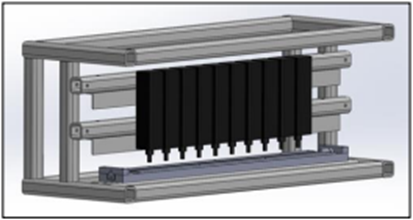 Possible embodiment of the technology
POTENTIAL AREAS OF APPLICATION
- Refrigeration
- HVAC systems
- Micropumping and other micro-electromechanical systems, especially lab-on-a-chip setups
MAIN ADVANTAGES
- Highly energy efficient
- Valveless design
- Reconfigurable internal volume ratio
- Optimizable to many applications
STAGE OF DEVELOPMENT