BACKGROUND
Per- and polyfluoroalkyl substances (PFAS) are highly persistent “forever chemicals” used in products like firefighting foams, textiles, and coatings, where strong C-F bonds make them resistant to breakdown and prone to long-term accumulation in water, soil and biota. Growing links to cancer, immune and developmental effects, combined with tightening drinking water standards and mounting clean-up liability, mean that simply concentration PFAS into sorbents is no longer enough. There is a clear need for scalable technologies that can destroy PFAS under practical operating conditions.
SUMMARY OF TECHNOLOGY
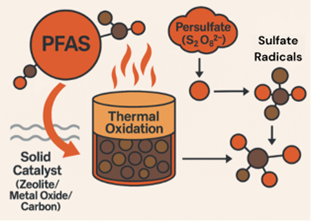
Oklahoma State researchers have created a PFAS destruction process based on thermal oxidation that uses solid reaction support materials together with thermally activated sulfate radicals to break the strong C-F bonds in PFAS at moderate temperatures (~60-90 °C). This innovation offers a scalable, cost-effective, and environmentally safe alternative to high-energy technologies by driving PFAS remineralization products such as fluoride ions, CO2 and sulfate ions, without relying on high temperature, UV, electrochemical or supercritical conditions. This approach is compatible with a broad range of solid reaction support materials, can treat both dissolved PFAS and those adsorbed on solid sorbents, and is adaptable to in situ or ex situ configurations, making it well suited for industrial, municipal, and environmental remediation settings. By directly addressing the current gap between simple separation and true destruction under practical operating conditions, this technology is positioned to help regulated entities meet tightening PFAS standards while minimizing energy use, secondary waste, and toxic byproduct formation.
POTENTIAL AREAS OF APPLICATION
- In Situ Chemical Oxidation (ISCO)
- Contamination/Hazard Cleanup
- Landfill Leachate Treatment Systems
- Semiconductor Manufacturing
- Petroleum Refining & Petrochemicals
- Ex Situ Water Treatment System
- Metal Plating & Surface Treatment Facilities
- Food Packaging Manufacturing Waste Processing
- Textile & Apparel Manufacturing
MAIN ADVANTAGES
- Operates at moderate temperatures (60-90 °C)
- Applicable for in situ and ex situ PFAS remediation
- Produces minimal harmful byproducts
- Thermally activated sulfate radicals with solid surfaces of reaction support materials
- Broad ranges of reaction support materials compatible with the invented system
- Capable of destroying PFAS adsorbed on solid adsorbents
- Lower energy consumption compared to other PFAS destruction technologies such as incineration, hydrothermal treatment and plasma arc