BACKGROUND
The construction of reinforced concrete columns remains one of the most labor-intensive and quality-sensitive tasks in building and infrastructure projects, including highways, airports, industrial facilities, and multi-story structures. Traditional methods rely on extensive formwork, manual rebar placement, and careful consolidation, all of which introduce delays, cost, and variability in structural performance. Existing large-scale 3D concrete printers cannot address this challenge as they are limited to depositing thin, layered mortar walls that lack embedded reinforcement and often fail to achieve the compaction and tensile reliability required for load-bearing vertical elements. These limitations prevent current additive manufacturing systems from producing structural columns suitable for code-compliant construction. Therefore, there is a need for a concrete-printing apparatus capable of forming reinforced, structurally sound vertical members with consistent consolidation, reliable geometry, and reduced manual labor.
SUMMARY OF TECHNOLOGY
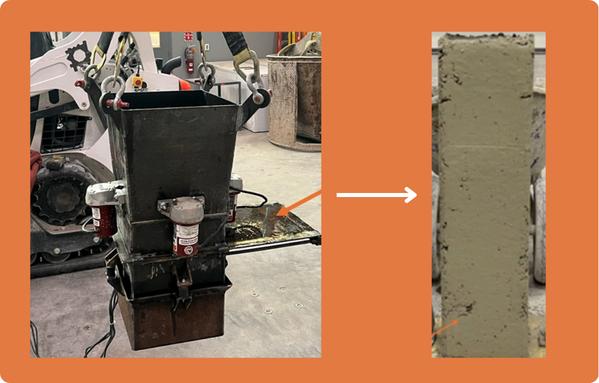
Oklahoma State researchers have developed Rocket, an apparatus for 3D printing reinforced concrete columns by depositing concrete around a pre-assembled rebar cage using a vertically oriented printing system. The machine includes a vibrating nozzle configured to deliver concrete to the forming region, a drag box positioned above the nozzle to shape and support the fresh material, and a grout shroud arranged to apply a finishing material to the column surface as the machine body moves upward. The system is designed to consolidate concrete around reinforcement, maintain column geometry during life, and improve surface quality without requiring traditional formwork. This 3D concrete printing device enables the automatic fabrication of vertically reinforced concrete columns suitable for building and infrastructure applications, while transforming the typical timeline associated with concrete column construction.
POTENTIAL AREAS OF APPLICATION
- Industrial Facility Construction
- Parking Garage Construction
- Highway Infrastructure Development
- Warehouse Construction
- Airport Infrastructure Construction
- Port and Marine Infrastructure Construction
MAIN ADVANTAGES
- Prints structural concrete directly around pre-tied rebar
- Eliminates traditional column formwork
- Vibrating nozzle improves consolidation
- Portable, lifetable crane design
- Reduces schedule duration for column dense projects
- Enables continuous vertical slipforming
STAGE OF DEVELOPMENT